
at NIT Raipur
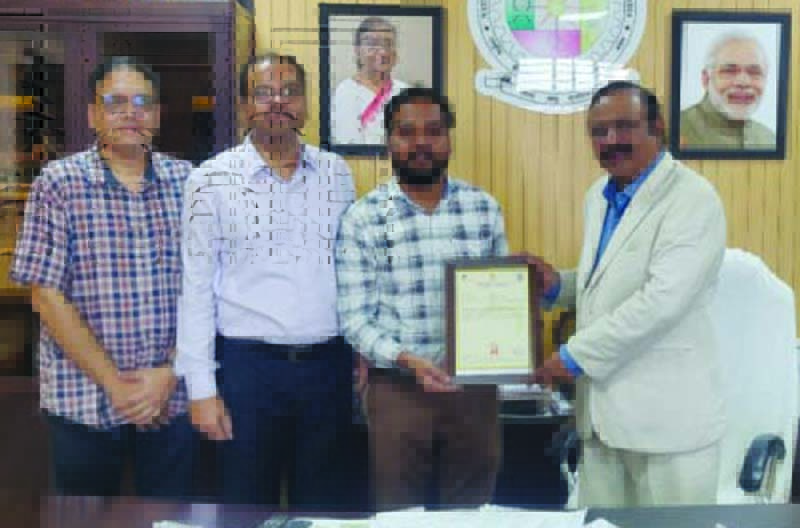
Raipur, Chhattisgarh —22 February 2025 Researchers from the Department of Biotechnology at the National Institute of Technology (NIT) Raipur have developed and patented a new way to make Cerium Oxide Microtubes (CeO₂-MTs). This innovation, led by Mr. Dilip Kumar Chandra, Dr. Chinmaya Mahapatra, and Dr. Awanish Kumar, has exciting potential in drug delivery, tissue repair, and medical implants. The pioneering work was carried out by Mr. Dilip Kumar Chandra, a Ph.D. scholar who joined NIT Raipur in 2022, under the able guidance of Dr. Chinmaya Mahapatra and Dr. Awanish Kumar. Mr. Chandra is also a regular employee of NIT Raipur, contributing significantly to both research and institutional development. He has published more than 8 research papers in internationally reputed SCI and Scopus indexed journals to date
 .
.
Expressing his pride, the Director of NIT Raipur congratulated the team, acknowledging their invaluable contribution to the institute and the nation. “This patent is not just a testament to the hard work and dedication of our researchers but also a reflection of NIT Raipur's commitment to advancing scientific innovation,” the Director stated.
What Are Cerium Oxide Microtubes?-Cerium Oxide Microtubes are tiny, tube-shaped materials made from cerium oxide, known for its antioxidant properties. Think of them like super-thin straws, about 400 times thinner than a human hair. Their hollow, porous structure makes them useful in healthcare.
How Are They Made?- The process is simple and effective: 1. Base Material: Polycaprolactone (PCL) nanofibers are used as temporary molds. 2. Coating: Cerium oxide is layered onto these fibers using water. 3. Heating: The coated fibers are heated at 440°C for 5 hours. This burns away the PCL, leaving hollow novel cerium oxide microtubes.
What Do They Look Like?- These tubes are about 280 nanometers wide, confirmed through advanced imaging techniques like X-ray diffraction and electron microscopy.

How Safe Are They for Cells?- (Cytocompatibility Study)- Researchers tested these microtubes on mouse muscle cells (C2C12) and found: Cell-Friendly: They don’t harm cells and have very less toxicity to cells. Stress Protection: They protect cells from harmful molecules called reactive oxygen species (ROS). Even under high stress (like exposure to hydrogen peroxide), the cells stayed healthy.
Real-Life Applications- 1. Tissue Engineering: Helps new muscle and nerve cells grow, useful in injury recovery. 2. Antioxidant Therapy: Reduces cell damage caused by stress, similar to how antioxidants in fruits protect our bodies. 3. Drug Delivery: Can carry and release medicines precisely where needed, like a tiny delivery truck. 4. Blood Vessel Repair: Their tube shape mimics small blood vessels, aiding in vascular repairs.
Key Highlights:- Patented New Process: Quick and efficient method using electrospinning and heating. Cell Protection: Excellent at reducing oxidative stress, supporting healthy muscle cells. Versatile Uses: Suitable for drug delivery, tissue repair, and medical implants. Common Everyday Benefits: Faster Wound Healing: Speeds up recovery from muscle injuries. Improved Medicines: Delivers drugs more effectively to targeted areas. Safer Implants: Makes medical implants more body friendly. Tissue Repair: Supports new tissue growth, helpful in surgeries and healing injuries.
Expressing his pride, the Director of NIT Raipur congratulated the team, acknowledging their invaluable contribution to the institute and the nation. “This patent is not just a testament to the hard work and dedication of our researchers but also a reflection of NIT Raipur's commitment to advancing scientific innovation,” the Director stated.
